
How many students should a dance class have?
·Wootera
A dance class should have no more students than can complete the planned lesson with enough room to move normally, change partners, see the instructor and receive useful feedback.
The final capacity is the lower of two limits:
- The maximum occupancy permitted by the venue and applicable local requirements.
- The highest number that works in a realistic test of the specific class format.
There is no single number that suits every dance class. The same studio may support one capacity for solo technique, another for beginner partner work and a lower capacity for a workshop with large travelling movements.
Separate permitted occupancy from practical capacity
Start with the occupancy limit set by the venue, building rules and applicable fire or safety requirements. Never exceed it.
That figure does not necessarily show how many students can take part in a lesson effectively. A dance class also needs:
- space around moving dancers
- a clear area for demonstrations
- unobstructed doors and required routes
- workable partner changes
- clear views of the instructor
- enough access for the instructor to observe and help students
Treat permitted occupancy as the ceiling. The practical capacity of a class may need to be lower.
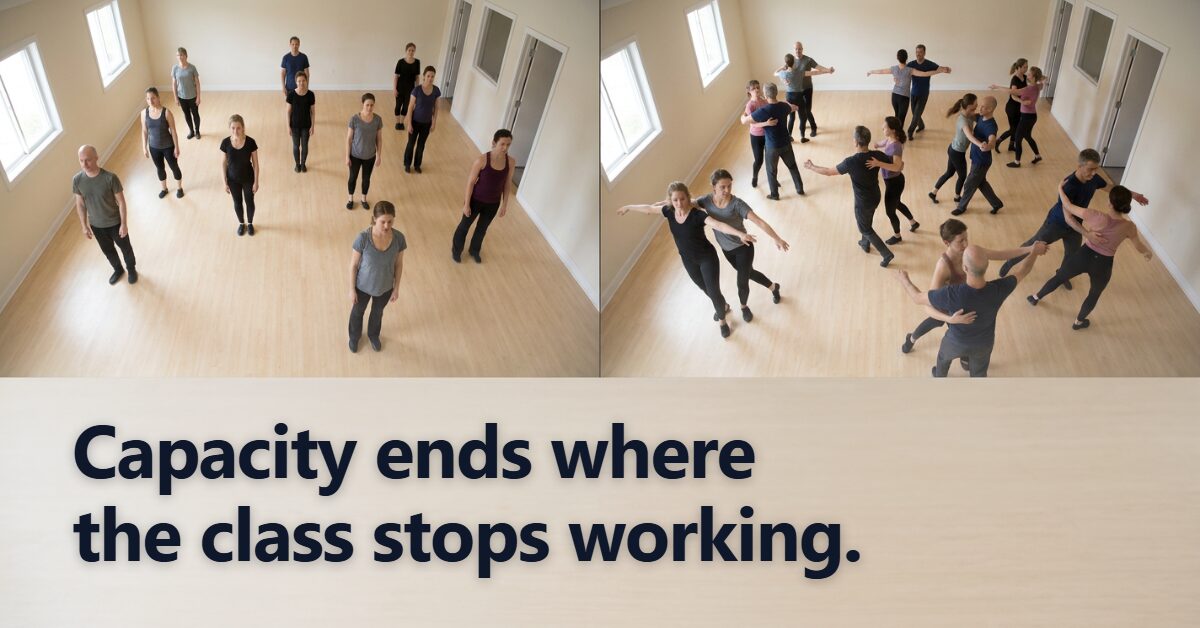
For example, a studio might be allowed to hold a particular number of people when they are standing still. The class may stop working well at a lower number once students begin turning, extending their arms or travelling across the floor.
A room test does not replace venue rules, local requirements or a professional safety assessment where one is required.
Test the room as it is normally used
Measure capacity on the usable dance floor, not the room’s total floor area. Exclude space occupied by speakers, storage, reception furniture, columns and other equipment. Keep doors, required routes and normal walkways clear.
Include the instructor’s working area. The instructor needs room to demonstrate movements at their normal size, see the group and move between students.
Arrange the room as it would be during a normal lesson. Include chairs, bags and portable equipment that are usually present. An empty studio can appear to hold more students than the same room during daily operation.
Before testing, agree on the signs that mean the class has reached its limit. These might include:
- repeated near contact between dancers
- students shortening movements to avoid others
- blocked doors, walkways or required routes
- slow or confusing partner changes
- poor views of the demonstration
- parts of the group the instructor cannot observe or reach
Using the same warning signs helps different instructors assess the room consistently.
Run one realistic capacity test
Choose a short sequence that represents the most demanding parts of the lesson. Include the movements and organisational situations that usually require the most space, such as turns, extended arms, partner work, changes of direction and travelling across the floor.
Begin with a group size that clearly works. Add one pair at a time for a partner class, or a small group at a time for a solo class. Repeat the same sequence after each increase.
Students should use their normal range of movement. Do not ask them to take smaller steps, avoid turns or change the choreography simply to fit more people into the room.
Check four areas during every round:
- Movement: Can students complete the planned steps at their normal size without repeated near contact or waiting for nearby dancers?
- Partner rotation: Does the actual rotation method work without crossed routes, long delays or groups collecting in one area?
- Sightlines: Can students at the sides, in rear corners and behind any columns see the instructor’s feet, body position and partner connection?
- Teaching: Can the instructor observe the whole group, reach students who need help and teach the planned material?
Check sightlines again after a partner change. A student may see clearly in the starting formation and lose that view after moving to another part of the room.
For partner classes, test an uneven balance of dance roles as well. Decide where unmatched students wait, what they do during each round and how they rejoin. Their position should not obstruct movement, rotation routes or views.
Stop increasing the group when one of the four checks fails. The previous successful headcount is the practical capacity for that class format.
For example, if 20 students can move comfortably and see the instructor, but the partner rotation becomes blocked at 22, the practical capacity is 20. There is no need to continue increasing the number once an essential part of the lesson no longer works.
Record capacity by room and class format
Do not keep one practical capacity for every activity in the same studio. Record the room and class format together, then connect the approved number to the relevant schedule and reservation limit.
zonno dance is a system for managing dance schools and studios, including schedules, bookings, students, payments, attendance and passes. Schools can use it to manage regular classes, workshops and other events in one place.
A capacity record can use this structure:
| Room and class format | Tested capacity | First constraint above the limit | Retest trigger |
|---|---|---|---|
| Studio A, beginner partner class | Enter result | Rotation route | Rotation method changes |
| Studio A, solo technique | Enter result | Rear-corner sightline | Room layout changes |
| Studio A, travelling workshop | Enter result | Movement space | Workshop content changes |
Add short notes about:
- the sequence used in the test
- the room arrangement
- the partner rotation method
- the location of waiting students
- any equipment present
These details allow another manager or instructor to reproduce the test and understand why the capacity was chosen.
Retest when the conditions change
A tested capacity remains useful only while the conditions behind it stay similar. Test again when:
- furniture or equipment moves
- the usable floor area changes
- the lesson begins using larger or faster movements
- the partner rotation method changes
- the instructor uses a different group arrangement
- a workshop introduces different material
- staff or students repeatedly report crowding, blocked views or delayed rotations
You do not need to retest after every minor timetable change. Retest when something affects movement space, routes, sightlines or the instructor’s ability to teach the group.
Frequently asked questions
Can dance class capacity be calculated from floor area alone?
No. Floor area can support initial planning, but it does not determine practical capacity by itself. Columns, equipment, instructor space, movement patterns, rotation routes and sightlines can make two rooms of the same size work differently.
Should beginner classes have a lower capacity than advanced classes?
Not automatically. Beginners may need clearer demonstrations, simpler rotation instructions and more individual correction. Advanced choreography may involve larger or faster movements. Test the actual lesson rather than setting capacity by level alone.
What should a dance school do when partner numbers are uneven?
Include an uneven balance in the capacity test. Define where unmatched students wait, give them a task for each round and explain how they rejoin. Check that their position does not block movement, rotation routes or views of the instructor.
How should a school manage different capacities for the same room?
Label each capacity by both room and class format. Add the number to the relevant schedule or reservation limit, and make the reason available to instructors and reception staff. Retest that capacity when the layout, lesson content or class organisation changes.