
How to praise dance students without making empty promises
·Wootera
Show dance students their progress by comparing their current performance with their own earlier performance. Name the specific change you observed, explain why it matters and give them one realistic next step. If progress is slow, acknowledge both the improvement and the work that remains.
General praise does not show what changed
“You’re doing great” may sound encouraging, but it gives the student little useful information. They do not know whether their timing, balance, memory, technique or independence has improved. They also cannot use the comment to guide their practice.
Useful praise works as feedback. It points to something the instructor observed:
- The student stayed on the beat for more of the sequence.
- They recovered after a mistake instead of stopping.
- They completed a turn without watching the instructor.
- They needed fewer verbal prompts.
- Their weight transfer became more controlled.
Not every encouraging comment needs a detailed technical explanation. One short sentence can still be specific. Instead of saying, “That was much better,” say, “You kept your balance through the final turn this time.”
This tells the student what changed without suggesting that they have mastered the whole skill.
Compare students with their earlier performance
Students often compare themselves with someone who learns combinations quickly, has more experience or already performs at an advanced level. From that perspective, genuine progress can feel insignificant.
Redirect their attention to a more useful question: What can you do now that you could not do, or could not do consistently, before?
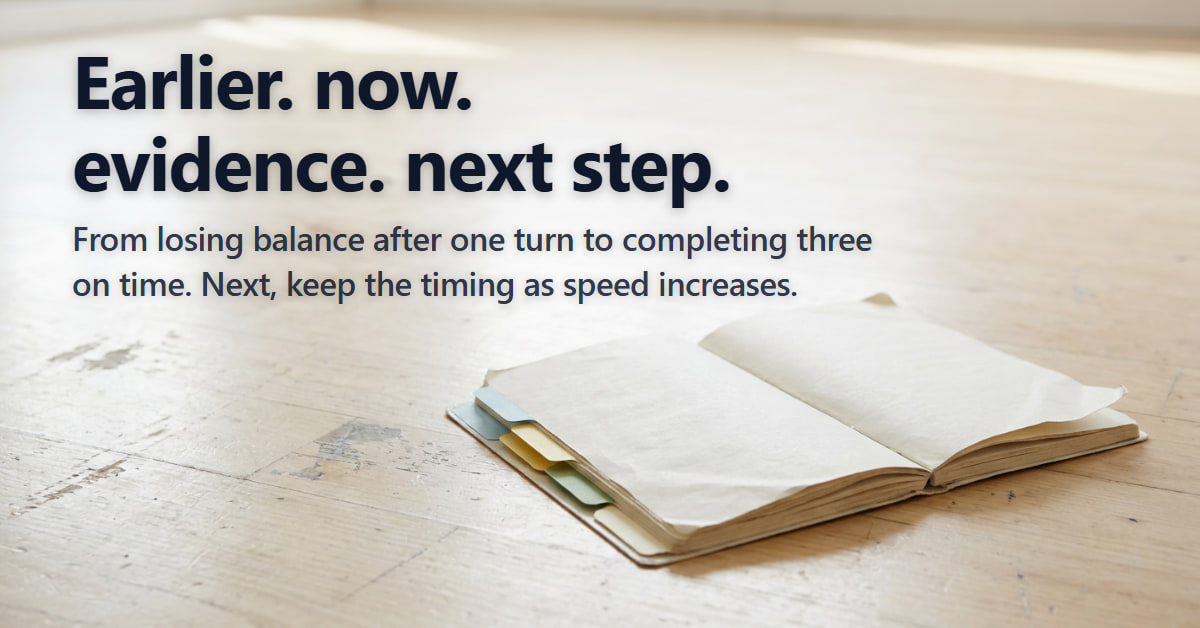
A student may still have less stable turns than the strongest dancer in the group. A month ago, however, they lost their balance after one turn. Today, they completed three turns while staying with the music. That is meaningful progress, even though the turns still need work.
Keep the comparison accurate. Do not say that a movement is technically correct when only the student’s confidence has improved. Technique, independence and confidence are different kinds of progress. Name the change you actually observed.
Use a four-part feedback structure
Specific progress feedback can follow four steps:
- Earlier: Briefly describe the previous difficulty.
- Now: Name the change and the evidence you observed.
- Why it matters: Explain what the change helps the student do.
- Next step: Give the student one realistic focus for future practice.
For example:
“A month ago, you were losing your balance after the first turn. Today, you completed three turns and stayed on time with the music. You are maintaining control for longer while rotating. Next, focus on keeping that control as you move into the following step.”
The four parts do not have to be delivered in one long statement. You might point out the improvement during class and give the next step at the end. The student still receives both evidence and direction.
A short progress note can use the same structure:
| Earlier | Now | Why it matters | Next step |
|---|---|---|---|
| Lost balance after one turn | Completed three turns on time with the music | Maintained control for longer while rotating | Keep the same control when moving into the next step |
The explanation of why the change matters should connect the observation to the skill. Better timing may help a student stay with a partner. Needing fewer prompts may show that they can perform more of the sequence independently.
Separate technique, independence and confidence
Not every improvement is technical. A student may perform a step with similar accuracy but need less help. Another may understand the sequence but still hesitate when dancing without the instructor.
Technical progress includes changes in rhythm, posture, balance, coordination, foot placement or movement quality.
Greater independence means that the student remembers more of the sequence, follows fewer prompts, corrects an error or continues after losing their place.
Observable signs of confidence may include committing to a movement, taking up appropriate space or returning to the sequence after a mistake. These behaviours do not prove technical mastery, but they can still represent real progress.
Name the category that changed. “You remembered the whole sequence without watching me” is more accurate than “Your technique is perfect.” It recognises greater independence while leaving room for further technical work.
This distinction also helps school leaders review teaching quality. Instructors should be able to explain what changed instead of relying on broad labels such as “better” or “more confident.”
Keep brief notes across several lessons
An instructor’s memory can be shaped by the most recent class. A difficult lesson may hide several weeks of improvement. One unusually successful attempt may make a skill seem more stable than it is.
Keep short notes on a few observable points, such as:
- how much prompting the student needed
- whether they stayed with the rhythm
- where they lost balance
- how much of the sequence they remembered
- whether they recovered after an error
- whether the skill remained stable at a different speed
Use consistent descriptions when comparing lessons. “Completed without a verbal prompt” is easier to interpret than “almost learned,” especially when several instructors teach the same student. Notes should support consistent feedback, not turn every lesson into a score.
zonno dance is a system for managing dance schools and studios, including schedules, reservations, students, payments, attendance and passes. Its student mobile app can show students their schedule and progress.
Acknowledge slow progress honestly
Sometimes a student is improving more slowly than they or the instructor hoped. Empty reassurance can make them feel misunderstood, especially when the remaining difficulty is obvious.
Recognise the progress while stating what still needs time:
“This is taking longer than either of us hoped, but your timing is more consistent than it was three weeks ago. The next step is to keep that timing when the sequence gets faster.”
When no clear technical improvement is visible, do not invent one. Recognise any observable work, explain what remains unstable and adjust the task if necessary.
“The turn is still inconsistent, but you are now identifying where you lose balance. For the next few lessons, we will isolate the entry instead of repeating the full combination.”
Effort can also be recognised without presenting it as technical progress. You might note that the student continued after several failed attempts, applied a correction consistently or asked a more precise question. Then state clearly which part of the skill still needs work.
A checklist for your next lesson
Before giving progress feedback, check that you can answer four questions:
- What could the student not do consistently before?
- What observable change did you see today?
- Is the change technical, independent or related to confidence?
- What is one realistic next step?
If you cannot identify an observable change, do not manufacture one. Give a clear correction, recognise specific effort where appropriate and continue recording what happens across future lessons.
Frequently asked questions
Should instructors praise effort when technique has not improved?
Yes, but name the effort you observed. For example, say that the student continued practising after several failed attempts or applied the same correction throughout the exercise. Do not imply that their technique improved if it did not.
How often should students receive progress feedback?
Give brief, specific feedback when you observe a meaningful change or a useful practice behaviour. Longer reviews can happen at natural points in a course. Base them on observations from several lessons rather than one unusually good or difficult day.
What should an instructor say when a student compares themselves with the best dancer in class?
Acknowledge what the student sees without making the other dancer their standard. Redirect attention to a personal comparison. Point out that they now need fewer prompts, recover more quickly or maintain the rhythm for more of the sequence than before.
Can video be used to show progress?
Yes, when recordings show comparable exercises and are made with appropriate consent. Keep the conditions as similar as practical. Tell the student which change to look for, such as timing, posture, balance or independence.