
How can dance schools make beginners feel less nervous about their first class?
·Wootera
Dance schools can make beginners feel less nervous by removing uncertainty at three points: before arrival, at the studio door, and during the first ten minutes of class. Tell students exactly what to expect, give them an obvious person and place to approach, and begin with clear instructions that require no dance knowledge. Instructors should also show through their teaching that mistakes are expected, rather than relying only on reassuring words.
Reduce uncertainty before the student leaves home
A beginner may be worrying about the dancing, but practical questions often add another layer of uncertainty. What should they wear? Do they need dance shoes? Should they bring a partner? Where is the entrance? What happens if they arrive alone or late?
Answer these questions in the booking confirmation or pre-class message. Do not make students search through an FAQ page, several social posts, and a venue website. Put the essential information in one place:
-
what clothing and footwear are suitable
-
whether changing rooms are available
-
what to bring, such as water or a towel
-
the full address and which entrance to use
-
when the studio opens and how early to arrive
-
where to check in
-
whether a partner is required
-
whether partners rotate during class
-
the approximate structure and length of the lesson
-
who to contact if they cannot find the room
Be specific where the building could cause confusion. “Studio 3” is not enough if a new visitor must enter through a courtyard, use the second staircase, and turn left after reception.
A useful pre-class message might say: “Please arrive 10 minutes early and check in at the desk by the main entrance. Comfortable clothes and clean indoor shoes are fine. You do not need to bring a partner. The class starts with an individual warm-up, followed by basic steps and partner practice.”
This does not require the student to feel confident. It gives them a sequence they can follow.
Make the first point of contact obvious
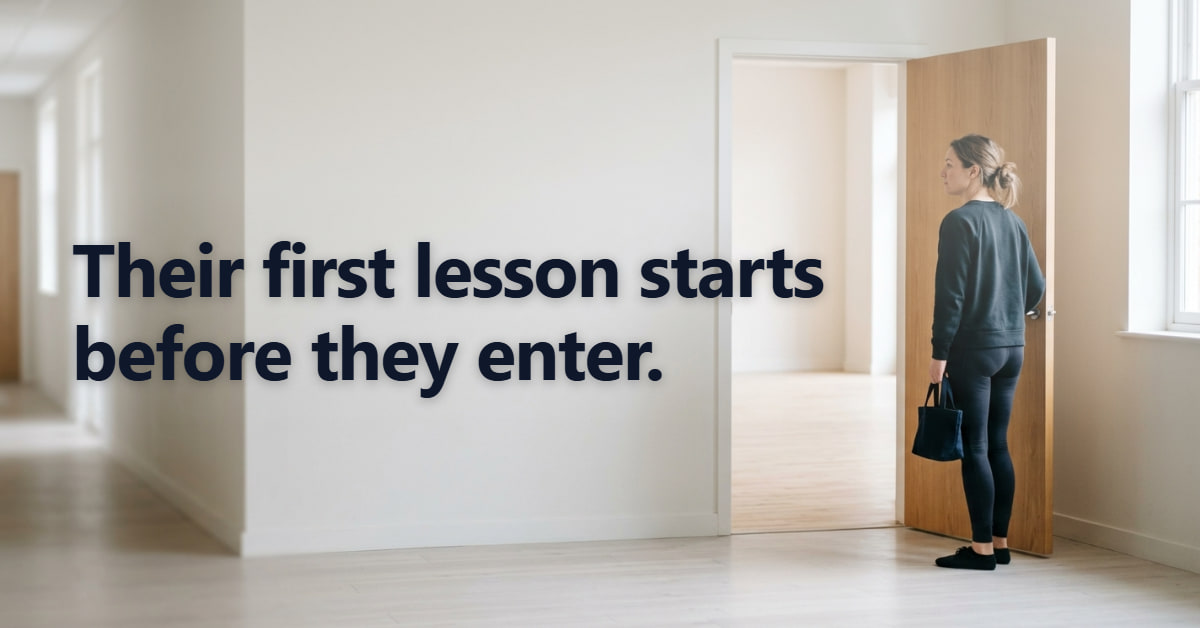
Arrival is the moment when written instructions meet the real studio. A friendly environment can still feel unwelcoming if a newcomer enters an empty hallway, sees several closed doors, and cannot tell whether anyone knows they are there.
Choose one clear check-in point and decide who is responsible for noticing new students. Depending on the school, that may be a receptionist, instructor, or assistant. The important point is that responsibility is assigned rather than assumed.
A useful welcome is personal and practical: “Hi, are you here for the beginner salsa class? I’m Maya. You can leave your things here, and the class will be in that room. I’ll let the instructor know it’s your first time.”
That sentence answers four immediate questions: Am I in the right place? Who can I ask? Where should I put my belongings? Does the instructor know I am new?
Avoid telling newcomers only to “make themselves at home.” They do not yet know what that means in your studio. Show them where to wait, where the toilets and changing rooms are, and what will happen next.
Use the first ten minutes to explain how the class works
An instructor may know that the class is informal, questions are welcome, and nobody is expected to succeed immediately. A beginner does not know any of this unless it is explained and demonstrated.
Before teaching steps, briefly cover the rules that affect a newcomer:
-
whether students will change partners
-
whether anyone may opt out of partner rotation
-
how to ask a question or request another demonstration
-
whether students can take a break when needed
-
how much material the class will cover
-
what students should do if they lose the sequence
The explanation can be short: “We’ll learn one small section at a time. I’ll demonstrate it first, then we’ll try it together. You can ask for another demonstration at any point. We usually rotate partners, but staying with one partner or sitting out a round is fine.”
Do not turn the opening into a long speech about confidence. Beginners need enough information to participate in the next activity. The instructor can reinforce the message through the rest of the class.
Start with an exercise that needs no dance vocabulary
The first exercise quietly tells students what kind of class they have entered. If the opening instruction includes unexplained terms, several directions at once, or an expectation to copy a fast sequence immediately, beginners may conclude that everyone else already knows more than they do.
Start with a task that can be understood in ordinary language. Demonstrate the complete movement once, break it into one or two actions, and then let the group try. For example: “Shift your weight onto your left foot. Bring your right foot next to it without putting all your weight down. Watch once, then we’ll do it together.”
Give students time to attempt the movement before adding styling, rhythm details, or technical corrections. Correct the point that allows them to continue, not every visible imperfection.
Group corrections are useful when several people need the same adjustment. If one person needs individual help, keep it brief and neutral. “Try a slightly smaller step” is easier to process than stopping the whole room to analyse that student’s mistake.
The first success should come from a well-sized task, not from praising students for something they cannot yet understand.
Normalise mistakes through instructor behaviour
Saying “mistakes are welcome” helps only if the instructor’s behaviour supports it. Students notice whether errors are treated as useful information, ignored until frustration builds, or exposed in front of the group.
One practical method is to demonstrate a common mistake without attaching it to a student. The instructor might say: “You may find yourself leaning forward here. That usually happens when the step becomes too large. Make the step smaller and keep your weight over the standing foot.”
This approach does three things. It shows that the mistake is predictable, explains why it happens, and provides a specific adjustment. The student is not left with a vague instruction to relax or try harder.
Tone also matters. Avoid jokes about having two left feet, being hopeless, or holding a partner back. Even when intended as reassurance, these phrases can reinforce the idea that ability is something students either have or lack.
A welcoming atmosphere cannot replace clear teaching. Beginners feel safer when instructions are understandable, corrections are usable, and the pace leaves room to try again.
Audit the beginner journey in three stages
Review the first-class experience from the perspective of someone who knows nothing about your routines. Divide the journey into three stages: before arrival, at the door, and during the first ten minutes.
At each stage, ask one question: What is a complete beginner expected to know without being told?
Before arrival, book a class using only the public information available to students. Check whether you can confidently choose clothing, find the entrance, and understand the partner policy.
At the door, enter as if nobody recognises you. Look for the check-in point, changing area, class location, and the person available for questions.
During the first ten minutes, listen for unexplained terminology and unspoken rules. Notice whether students know when to start, where to stand, how partner changes work, and what to do when they fall behind.
Write down one unanswered question or awkward moment at each stage. Then remove it before the next beginner class. Some concerns, including physical contact, health limitations, previous negative experiences, or social anxiety, may need individual support. A clear first-class journey cannot remove every fear, but it can prevent the school’s routines from creating unnecessary uncertainty.
Frequently asked questions
Should beginners be told that they do not need a partner?
Yes, if the class accepts individual bookings, say so clearly before the lesson. Also explain whether partners rotate and whether students can choose not to rotate, because “no partner needed” does not answer how partner work will happen.
How early should first-time students arrive?
Ask beginners to arrive early enough to check in, change, and find the room without rushing. Around 10 minutes is often practical, but the right time depends on the venue and your check-in process. State when the building opens so students do not arrive early and find a locked door.
Should an instructor ask who is attending for the first time?
The instructor should know who is new, but a public show of hands can make some students feel exposed. When possible, identify first-time students during check-in and welcome them individually. The instructor can then address the whole group without singling anyone out.
What should a school do if a beginner does not want physical contact?
Explain the level of contact the class normally involves and provide a clear way to opt out of an exercise or partner rotation. Offer an individual version where practical, and avoid asking the student to justify their choice in front of the group.
Beginners do not need to arrive feeling confident. They need a first-class experience that tells them what will happen, shows them where they belong, and treats mistakes as a normal part of learning.